The government file, kept whole
An order anyone can check, on a file no one can quietly change.
The section register, the noting, the I.D. note, the signature, the published order — one system keeps the whole life of the file, sealed act by act as it happens. What reaches the public page is the same instrument the section signed, and any reader can check it — without an account, without asking the office.
Nothing to install, and no account needed to read the public orders or verify a document. Every picture on this page is captured from the working system — nothing is a mock-up.
- टिप्पणीNoted
- प्रस्तुतPut up
- परामर्शConsulted
- हस्ताक्षरितSigned
- जारीIssued
- प्रकाशितPublished
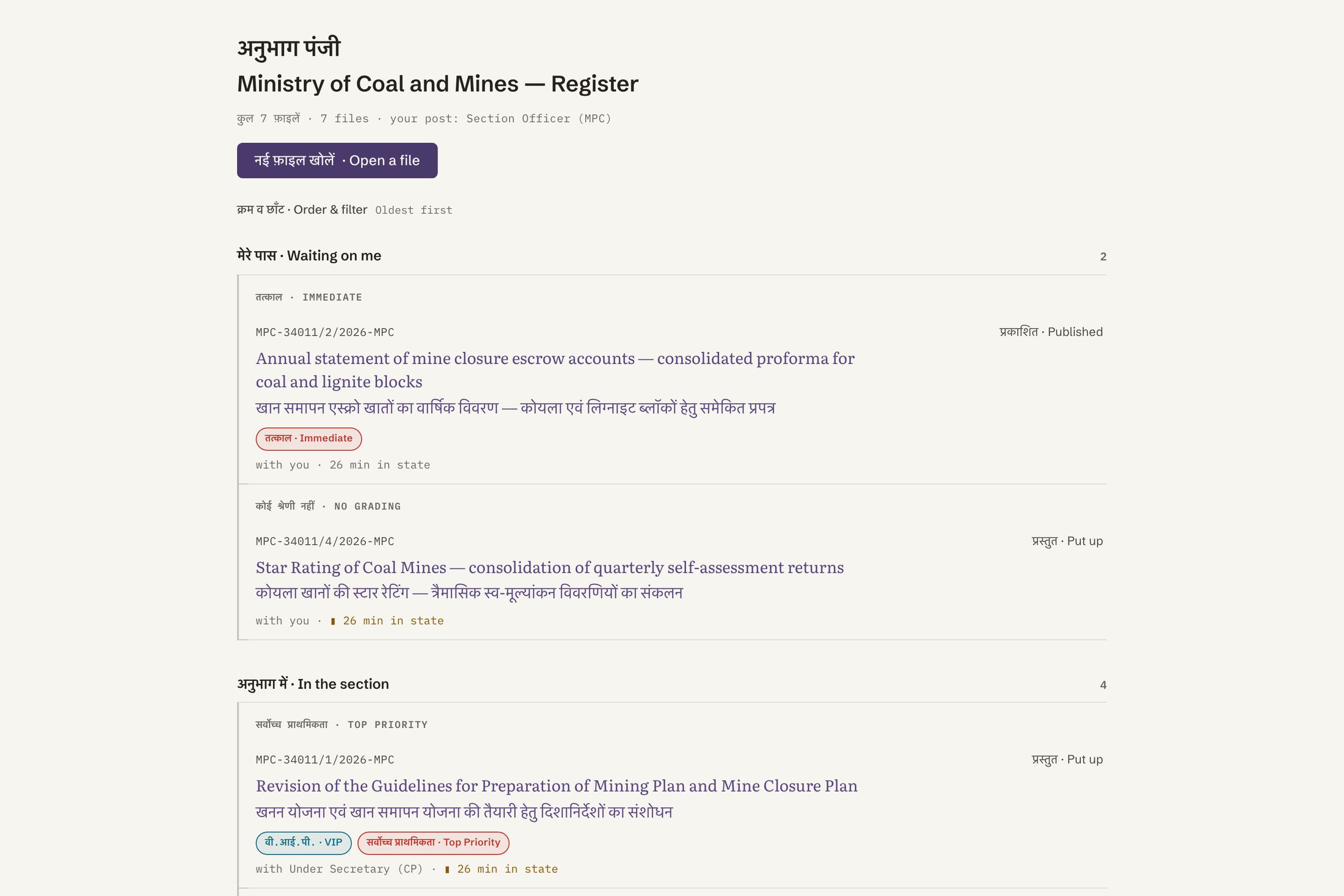
The file
Every file carries its own next step.
A file exists from its first minute — a number in the section’s own series, the desk that holds it, its urgency grading and its security marking. One panel tells the officer holding it what they can do now, in the Manual’s own words: approve the fair copy, or return it with the reason it must carry. The Dealing Officer who typed the draft stays on the record, and the file’s custody is never in doubt.

The record
The trail is the file — not a story told afterwards.
Every noting, every movement up and down the channel — who did it, when, in whose post. A return travels with what was asked; the resubmission answers it; both stay, in order, exactly as they happened. Wherever the file is — above you, below you, out on consultation — the register says so, and delay points at whoever holds it. For the officer who moved the file the same day, that line is testimony. An audit, a vigilance query, an RTI: the answer is the file itself.

Issue & publish
Inside first, then public — the same instrument, one system.
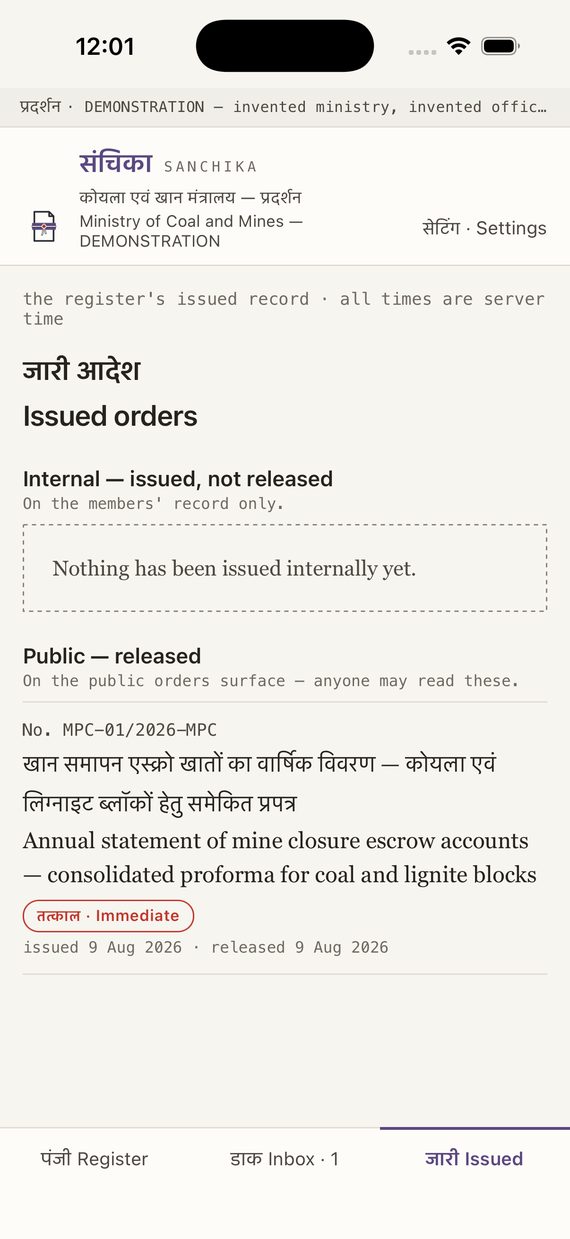
The instrument drafted, consulted and signed inside the section is released to a public orders page anyone can read — under the reference number it issued on, over the signature it issued with. The gap between the signed file and the copy on the website disappears: they are the same bytes, and the register can prove it.
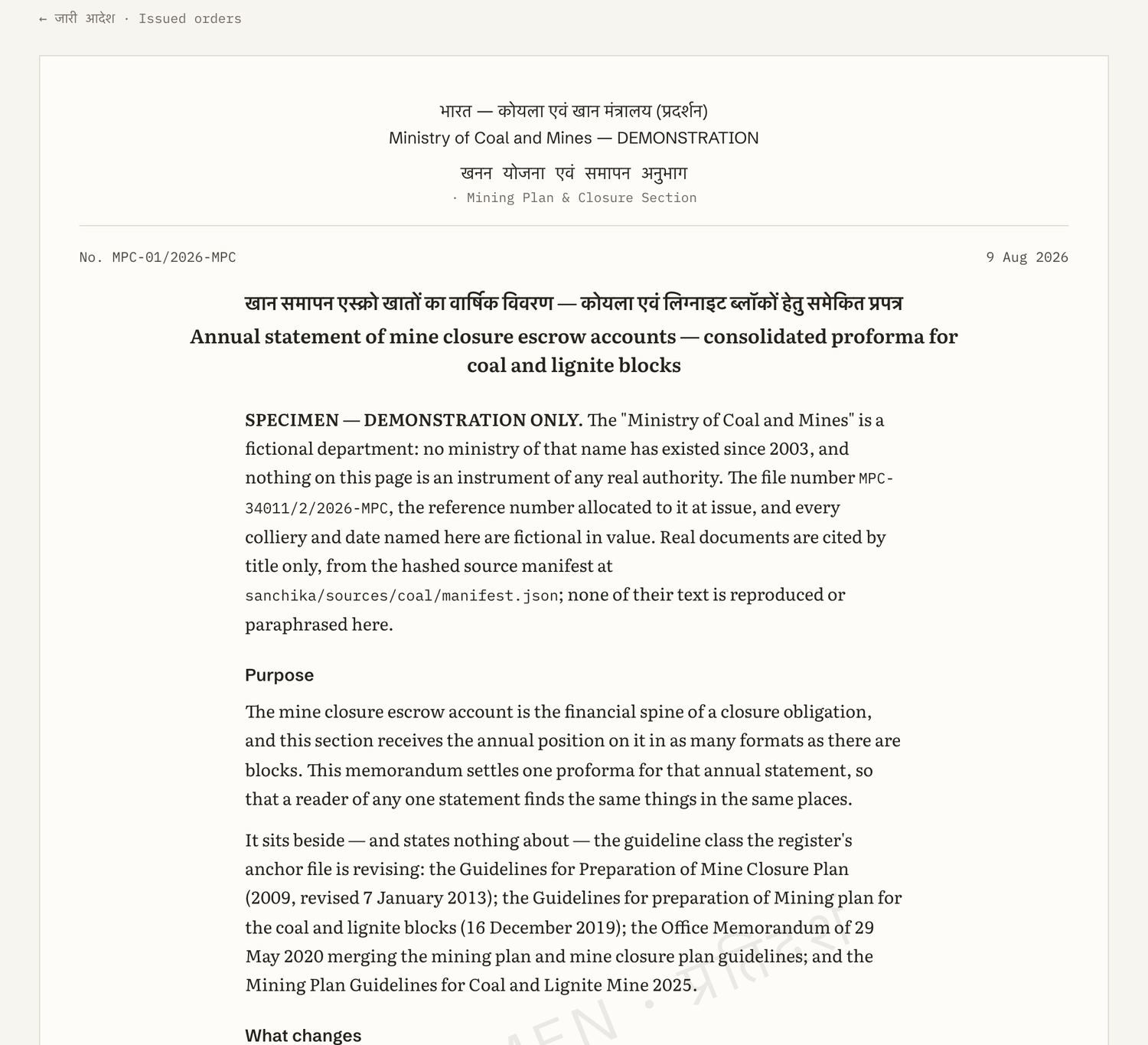
जाँच · The check
How a Sanchika order proves itself.
Today an order leaves the office as a PDF forwarded on WhatsApp — no seal, no trail, no way for the reader at the far end to know it is whole. Sanchika is what that copy should have been. Here is the entire mechanism, on one card — including what failure looks like, because a check that cannot fail loudly is not a check.
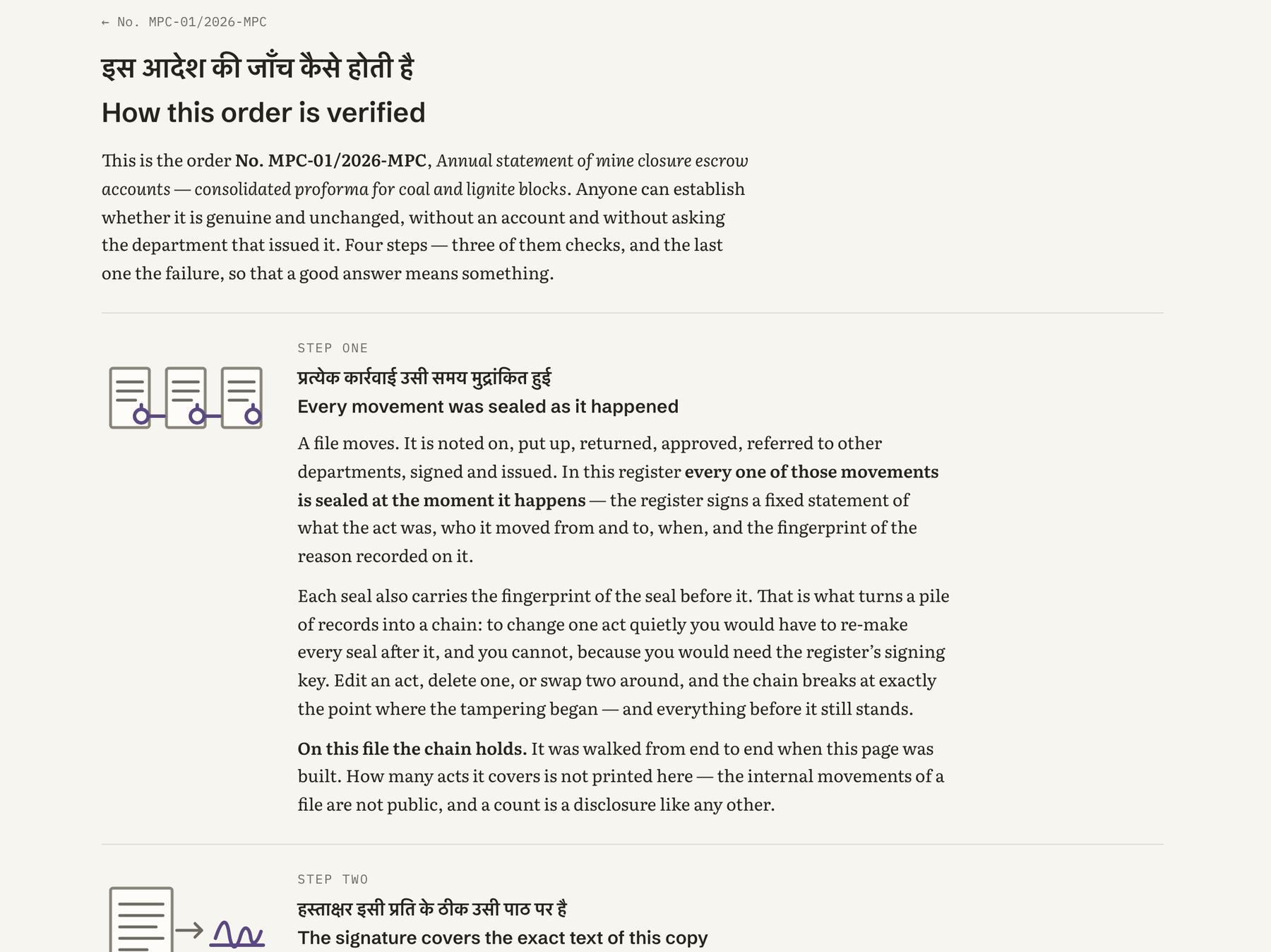
फ़ाइल की यात्रा, मुहर-दर-मुहरThe journey, seal by seal
- फ़ाइल खोली गई · File opened Dealing Officer (MPC)
- प्रस्तुत · Put up Dealing Officer → Section Officer · sealed over the act before
-
संशोधन हेतु वापस · Returned for revision
Under Secretary → Dealing Officer
“Restate the full supersession chain and confirm the escrow provisions.”
“Restate the full supersession chain…”“Minor typographical corrections only.” - पुनः प्रस्तुत · Resubmitted answers the return · both stay on the file
- हस्ताक्षरित · Signed over the exact bytes of the fair copy · against the post, never the person
- प्रकाशित · Published the public copy, compared character for character when you ask
✓श्रृंखला कायम है। The chain holds — walked end to end, every seal signed over the one before it.
✗जाँच यहीं रुक जाती है। The altered act breaks its seal, and every act after it stops verifying — like a torn page, it cannot be hidden. Everything before it still stands.
Check one
Every movement was sealed as it happened.
The register signs a fixed statement of each act — what it was, whose desk to whose, when — and every seal carries the fingerprint of the seal before it. To change one act quietly you would have to re-make every seal after it, and you cannot: that needs the register’s signing key.
Check two
The signature covers the exact bytes.
What the officer signed is a statement naming the sha-256 fingerprint of this precise copy, the post that signed, the file number and the time. Change one character and the signature stops matching. No page can be substituted after signature.
Check three
The published copy is compared against the register’s own history.
Character for character, against the revision the code was issued at — when you ask, not in advance. If there is a difference, you are shown every word of it. Nothing about you is recorded by asking.
And the failure
Designed, not feared.
Press the button on the card and watch the chain refuse. No failure is silent, and none of them is a blank page — a good answer means something only because a bad one shows itself.
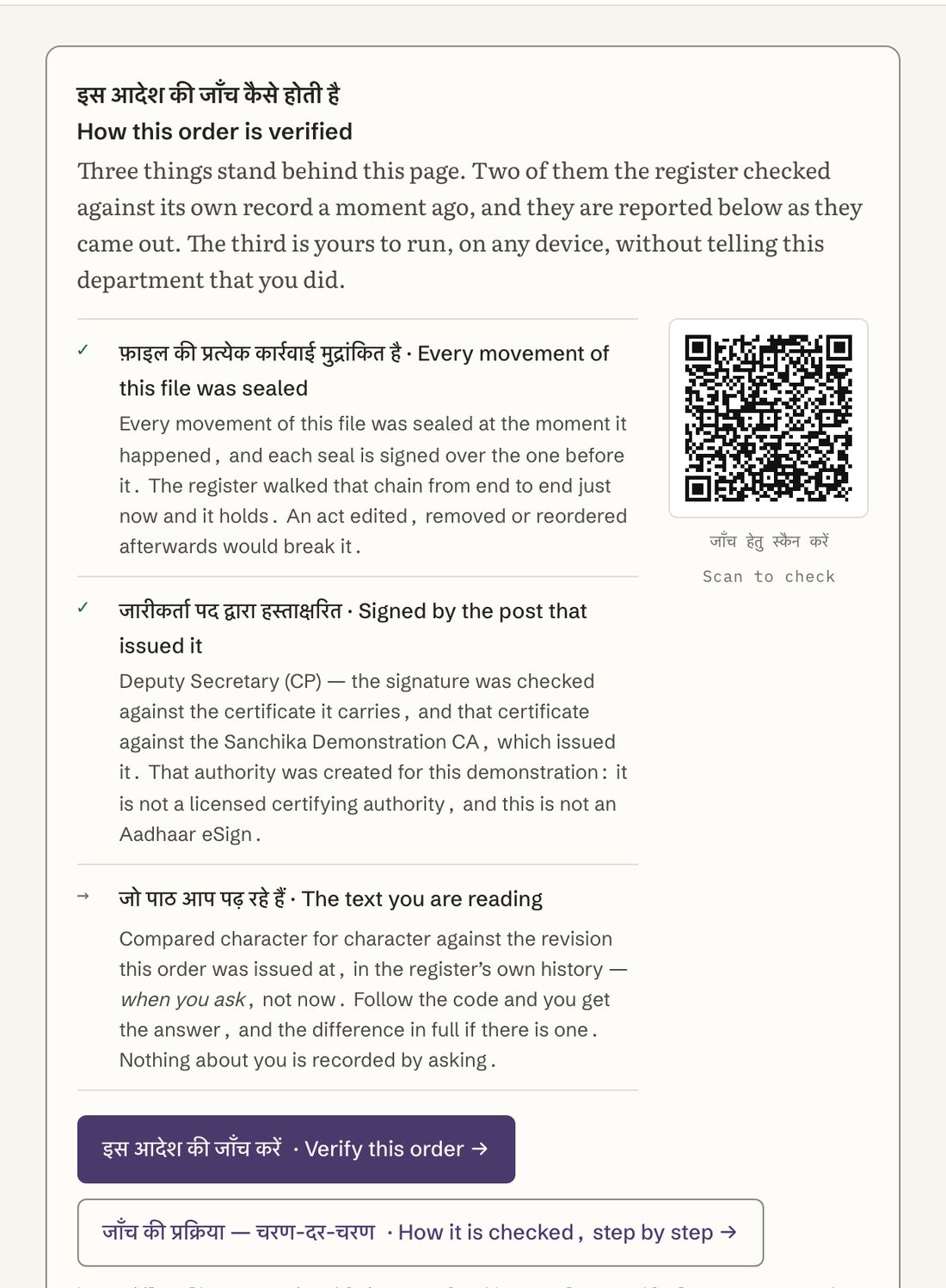
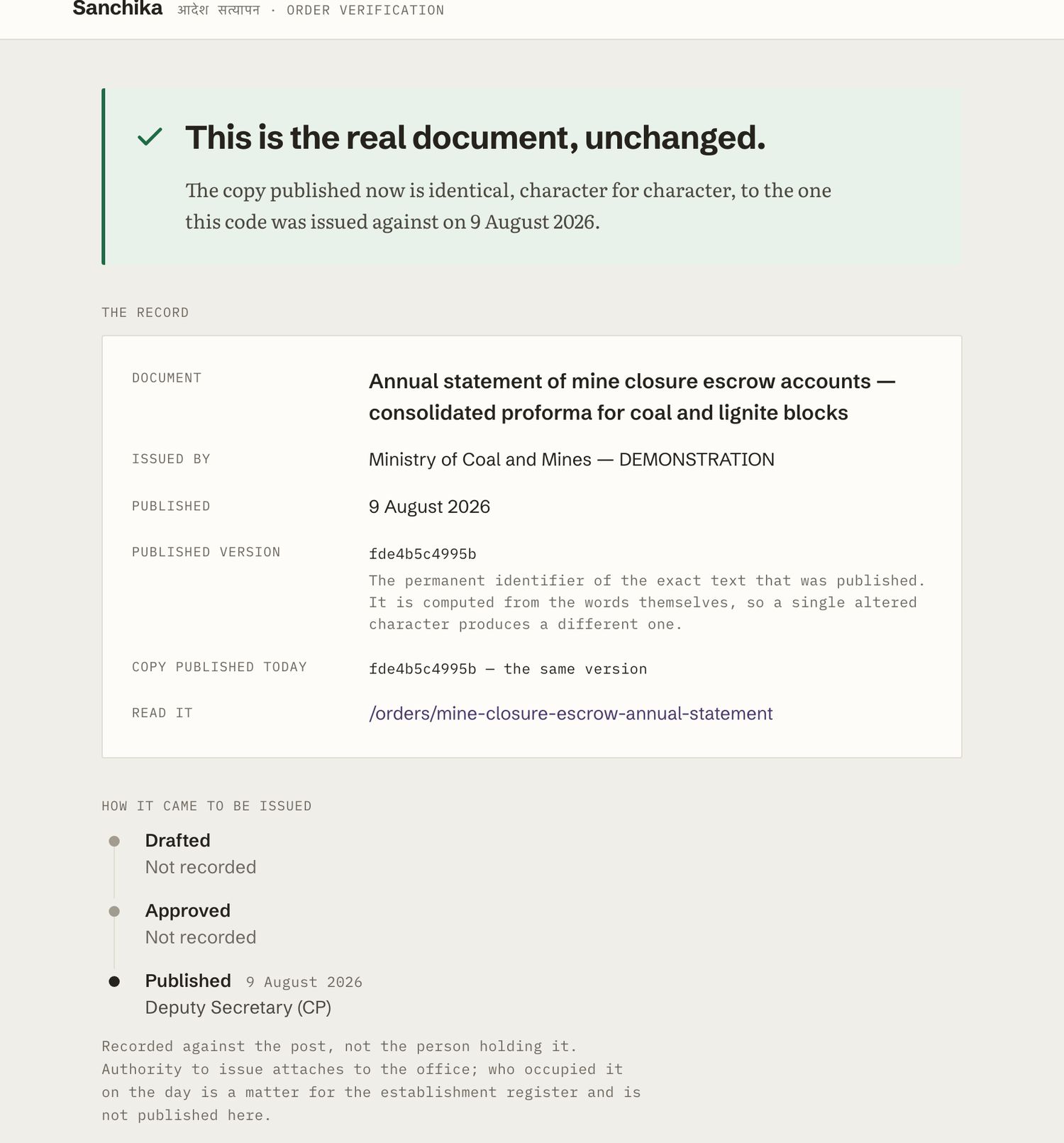
The real path is exactly this short: open any order on the public orders page → scan its code → the register answers. And every order carries its own plain-language page — इस आदेश की जाँच कैसे होती है · How this order is verified — four steps, the last one the failure, so that a good answer means something.
Every seal here is real cryptography under the openly-named Sanchika Signing Authority — that proves the mechanism, not a legal instrument. Where the law requires Aadhaar eSign or a licensed certifying authority, the design takes them at the same seam.
In your pocket
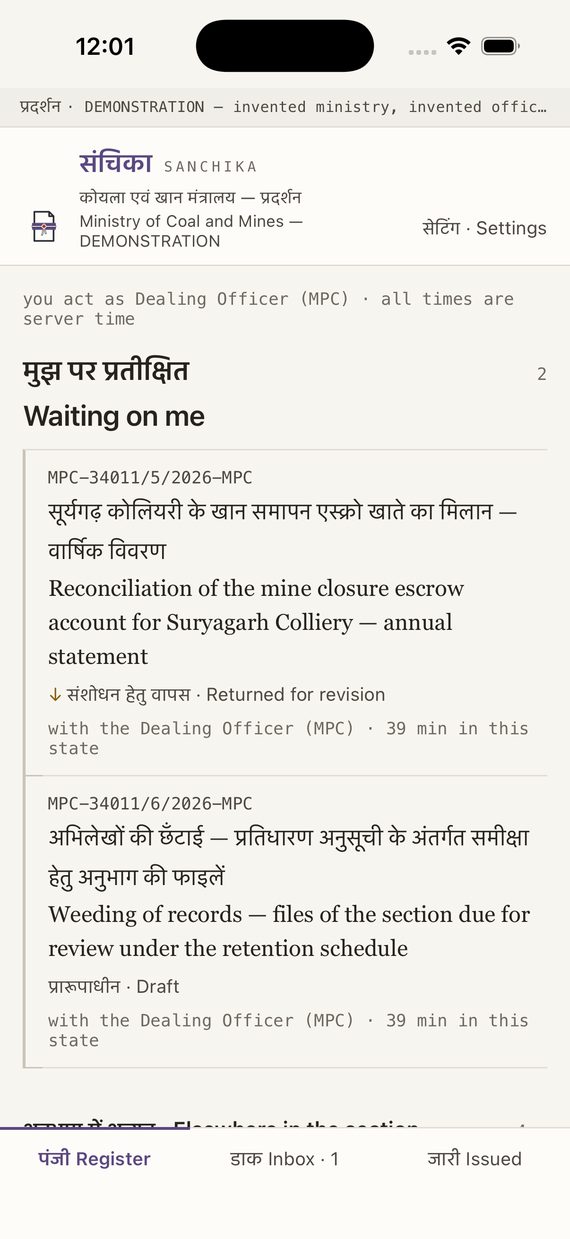
iOS and Android — as immediate as the chat apps, and everything on the record.
The whole file on your phone: read a noting, reply on a consultation, clear your desk. The officer on tour is still on the record — and the signature ceremony on the phone, three sentences and one act, seals exactly as it does at the desk. Easier than handing anyone a token.
iOS · Android · आपकी भाषा में — in your language
Not all-or-nothing
Meets your desk where it already is.
Bring documents — and tools — in.
A Word draft imports and converts to the register’s clean form, recorded as brought in — one act, no history invented, no badge of shame. The templates carry the letterhead and the allocated file number, so starting in Sanchika is less work than opening a blank page — and nothing is ever retyped.
Start at any stage — even mid-file.
A matter doesn’t have to begin in Sanchika to live in it. A file already consulted and signed on paper enters as it stands: the officer uploading it attests the digitised copy is verbatim, that attestation is itself signed and kept beside the scanned instrument — and the file carries on from that point, on the record from there forward.
आपकी भाषा · Your language
The officer’s language, the record’s own words.
The interface reads in Hindi, Telugu and Kannada today — English always beside it — and its frame holds all twenty-two scheduled languages as their catalogs are verified. The record itself stays exactly as written; a translation is never mistaken for the file.
Signed & sealed
The signing rule, made painless.
Since 15 January 2024 the rule is that every forwarding of an e-file is signed — the rule is ahead of the culture. In Sanchika each act seals itself in the doing: no token to fetch, no ceremony to postpone, and verification asks no account and no permission.
Retention, by the book
Files close with a category, and a clock.
Permanent or term-limited, the retention clock starts on closing; grading and security markings travel with the file. Weeding becomes a decision on the record, not an accident.
साफ़ बात
Said plainly.
It runs today.
The whole of it runs today: the register, the noting, the trail, the seals, the public orders, the verification, the apps. Open an office, walk a file from draft to a published order, and check it from any phone.
गवाही, निगरानी नहीं। Testimony, not surveillance.
The register records acts on files — never attention. Not recorded, by design:
- who read a file, when, or for how long;
- login hours, idle time, typing speed;
- rankings, league tables, cross-officer comparisons;
- anything on a notification beyond the post and the file number.
What the paper file kept, Sanchika keeps. What the paper file never contained, Sanchika does not record. For the officer who did the work, the file is the best witness in the building.
It enforces no new rule.
Every rule Sanchika makes visible is already in the Manual — the recorded reason, the channel of submission, the signed forwarding mandated since January 2024. The Manual already names what this system keeps: the Standing Guard File, the Standard Process Sheet, the Master Circular that supersedes its predecessors. No learning curve — only the office’s own words, made the path of least resistance.
What the seals are — and are not.
Today every act is sealed under the openly named Sanchika Signing Authority. That proves the mechanism, not a legal instrument: where the law requires Aadhaar eSign or a licensed certifying authority, the design takes them at the same seam, with no change to the record.
Questions, corrections, or a register you would like kept this way — srikanth@yousquare.ai.
जो हुआ, वही दर्ज है; जो दर्ज है, वही प्रमाण है।
The office procedure, exactly as written — and provable, act by act.